Fobzu Co-Hosts Conference on International Education Community Response to Scholasticide in Gaza
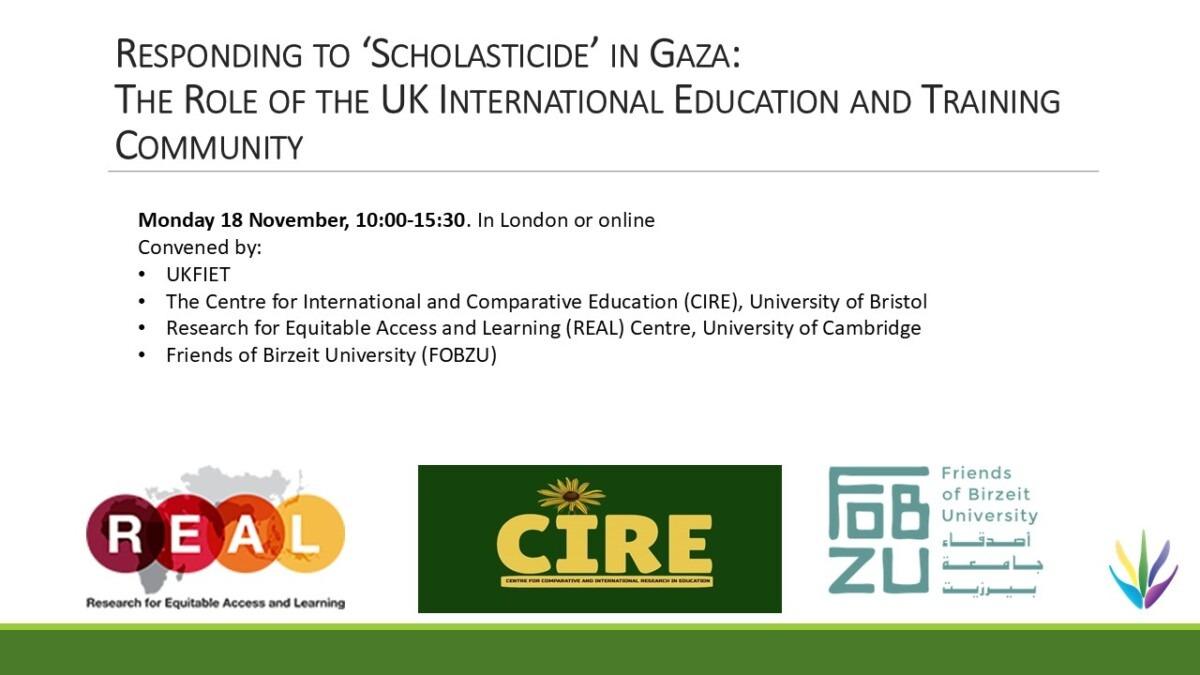
On November 18, 2024, Fobzu co-organised the conference Responding to ‘Scholasticide’ in Gaza: The Role of the UK International Education and Training Community. Held in London and online, and in partnership with UKFIET, CIRE (University of Bristol), and the REAL Centre (University of Cambridge), the event brought together Palestinian academics, education experts, and humanitarian advocates to address the devastating impact of the ongoing genocide on Gaza’s education system.
Chaired by Fobzu’s director, Omar Shweiki, the first session featured powerful testimonies and calls for support from the Emergency Committee of Gaza’s Universities. Despite significant risks, Dr Radwan Abu Rukba, Al-Aqsa University, joined the event online from Khan-Younis in Gaza and spoke about the psychological toll on students and faculty who continue to suffer from trauma and fear. He underscored the dire need for immediate support, including reliable internet access and technology, while stressing that a permanent ceasefire is the most critical requirement for any educational recovery.
Dr Nasreddine Almezaini, from the Islamic University of Gaza, emphasised Gaza’s universities’ historical resilience while reporting the devastating toll inflicted by Israel on Gaza’s higher education sector, including the deaths of hundreds of students and 119 academics—among them three current and former university presidents—and €200 million in losses. Despite these immense challenges, Dr Almezaini highlighted the resilience of Gaza’s educational institutions and called for international partnerships to assist in rebuilding.
Dr Ahmed Abu Shaban from Al-Azhar University spoke about the operational paralysis universities face, which can no longer depend on student fees. Faculty members are teaching without pay, driven by their commitment to education and their students. He and his colleagues emphasised the urgent need for international support to strengthen Gaza’s universities and avoid efforts that could undermine their role in the community, highlighting Isnad as a model for empowering Gaza’s universities.
The conference also addressed the broader historical context of the systematic destruction of Palestinian education. Dr Mezna Qato, a historian of Palestinian education at the University of Cambridge, spoke about how the term “scholasticide” encapsulates the ongoing Israeli effort to erase Palestinian identity through the destruction of educational systems. She emphasised that despite this, Palestinians have always found innovative ways to continue their education as an act of resistance and resilience.
Dr Abdel Razzaq Takriti, from Rice University, criticised Western academia for its complicity in the ongoing genocide, urging scholars to reject collaboration with Israeli institutions. He highlighted the need for collective, not individual, support for Palestinian educational institutions, as these institutions are vital to the existence of the Palestinian people on their land.
The second session, chaired by Professor Pauline Rose, University of Cambridge, explored the broader crisis in Gaza’s schools. UNRWA representative Unai Sacona gave a sobering account of the destruction Israel inflicted on UNRWA’s schools, 93% of which have been damaged or destroyed, with many functioning as shelters but still targeted. Sacona stressed the vital role of UNRWA in providing education to Palestinian refugees and highlighted the coordinated campaigns to dismantle it.
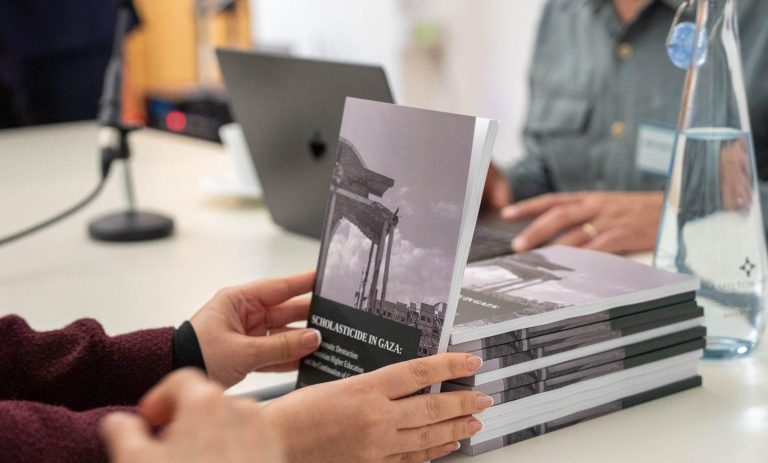
Professor Yusuf Sayed presented findings from the REAL Centre’s report, Palestinian Education Under Attack in Gaza, which detailed the cumulative impact of war, trauma, and starvation on students and teachers. Despite these challenges, Gaza’s educators continue to show extraordinary resilience, providing foundational learning and psychosocial support under dire conditions. The report concludes with recommendations for all actors to support efforts at resuming teaching and learning in Gaza.
Following the panel discussions, the conference held break-out discussions to address what actions the international education and training community could take to support their Palestinian colleagues. Key conference recommendations included rebuilding Gaza’s educational institutions, fostering equitable partnerships, and advocating for the continued operation of UNRWA.
Practical recommendations included developing a partnership guide outlining steps for sustainable collaboration between UK and Palestinian universities. The UK Network of Educationalists for Palestine also emerged as a vital initiative to strengthen solidarity and support for Palestinian higher education.
The conference highlighted the existential threat to Gaza’s education system and the extraordinary resilience of its academic community. A full summary report, including detailed recommendations, is available here.